Lighting Up Lives: The Rise of Solar Energy
Across developing nations, a quiet energy revolution is taking hold. Propelled by plummeting panel costs and market forces, solar power is emerging as the most economical choice for new electricity generation in 90% of the world. This shift is particularly pronounced in Africa, Asia, and Latin America, where abundant sunshine meets urgent energy needs.
In 2024 alone, Africa installed an impressive 2.4 GW of new solar capacity, with projections indicating a 42% surge in 2025. According to the Global Solar Council, the continent is on track to add 23 GW more by 2028, with growth diversifying across at least 18 countries installing 100 MW or more each.
What’s driving this remarkable growth? Several factors converge:
- Chinese manufacturing has dramatically reduced panel costs
- Private imports have increased accessibility
- Market dynamics now favor renewables over fossil fuels on cost alone
- Bottom-up approaches, as seen in Pakistan, have enabled massive scale through reduced import duties
The economics speak volumes: solar is no longer just an environmental choice but an economic imperative. In countries where energy access has historically lagged, solar offers a leapfrog opportunity—bypassing traditional grid infrastructure for nimble, distributed solutions that can be deployed rapidly and scaled incrementally.
Key Solar Initiatives and Projects
Despite possessing 60% of the world’s best solar resources, Africa currently generates only 3% of its electricity from solar PV. This vast untapped potential has spurred ambitious continental initiatives aimed at transforming the energy landscape.
The African Development Bank’s “Mission 300” stands as perhaps the most ambitious, aiming to connect 300 million Africans to electricity by 2030 through a planned $90 billion investment. As reported by Green Central Banking, this initiative represents one of the largest coordinated efforts to address energy poverty in history.
Equally impressive is the “Desert-to-Power” program, targeting 10 GW of solar deployment across 11 countries to benefit 250 million people. This initiative harnesses the Sahel region’s abundant sunlight, transforming an environmental challenge into an energy opportunity.
Morocco’s Noor Ouarzazate Solar Power Station exemplifies what’s possible. This 580 MW facility stretches across the Sahara, utilizing innovative concentrated solar power technology. Financed by the African Development Bank and World Bank, the project demonstrates how international financing institutions can catalyze transformative infrastructure.
Market leadership is diversifying, with South Africa and Egypt currently leading installations, but emerging markets are gaining ground. According to Residential Solar Panels, countries like Kenya are experiencing rapid solar adoption, with a mix of utility-scale projects and distributed systems.
Overcoming Challenges in Solar Implementation
Despite promising growth, solar expansion in developing nations faces substantial hurdles. Chief among these is the financing gap—capital costs in Africa are a staggering 3-7 times higher than in developed countries, reflecting perceived risk premiums and limited access to low-cost capital.
The investment disparity is stark: Africa receives only 3% of global energy investment despite needing $200 billion annually to meet energy access and climate goals, as noted by the Global Solar Council. While development finance institutions like the AfDB and World Bank provide crucial support, including European pledges of $15.5 billion, structural biases continue to limit private investment flows.
The economics present a paradox. Renewables are now 91% cheaper than new fossil fuel projects globally, according to the International Renewable Energy Agency, yet implementation challenges drive up the levelized cost of electricity (LCOE) in developing nations:
- Grid integration bottlenecks limit capacity to absorb new generation
- Permitting delays extend project timelines and increase costs
- Financing risk premiums elevate capital expenses
- Technical capacity gaps complicate maintenance and operations
Addressing these challenges requires coordinated action across policy, finance, and capacity building. Countries achieving the greatest solar penetration have typically implemented comprehensive frameworks addressing both financial and technical barriers simultaneously.
The Impact of Solar Energy on Communities
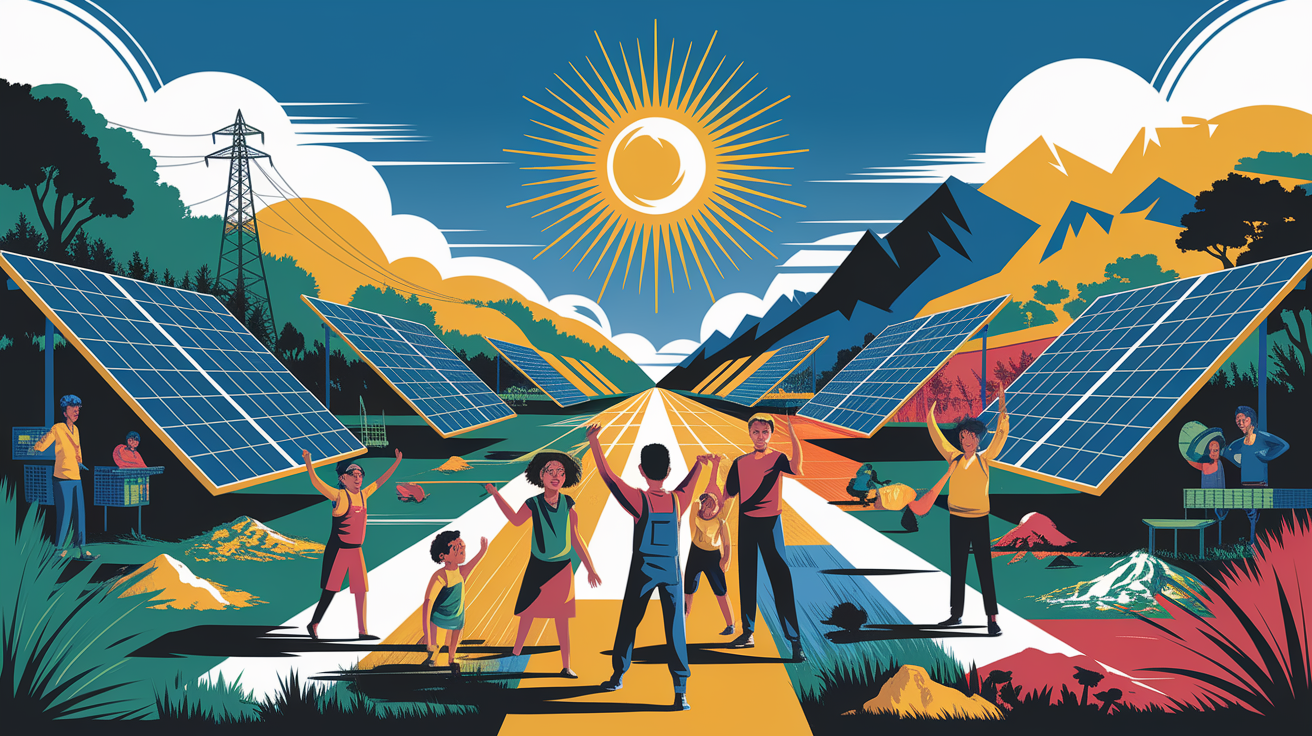
Beyond megawatts and investments, solar initiatives deliver transformative social impact. In rural communities across India and sub-Saharan Africa, micro-grids are reducing diesel dependence by up to 60%, simultaneously cutting emissions and energy costs. These systems don’t just provide power—they catalyze comprehensive development.
The employment effects are significant. Solar deployments create jobs across the value chain, from installation and maintenance to sales and support services. Importantly, these opportunities extend to historically marginalized groups—community solar projects are increasingly empowering women as technicians and entrepreneurs, while providing youth with pathways into the renewable energy sector.
The cascading benefits touch multiple Sustainable Development Goals:
- Reliable power enables longer study hours for students
- Health clinics can refrigerate vaccines and operate essential equipment
- Small businesses extend operating hours and introduce new services
- Mobile phone charging supports digital inclusion and financial access
Pakistan offers a compelling case study of bottom-up adoption. Amid economic challenges, private citizens have embraced solar to enhance energy security, as documented by Global Capital. This transition from dependency on centralized grids to distributed generation illustrates how solar creates resilience at both household and community levels.
Shining a Light on the Future
The trajectory for solar energy in developing nations points unambiguously upward. With Africa alone projected to add 23 GW by 2028, and similar growth expected across Asia and Latin America, the question is no longer if solar will become dominant, but how quickly the transition will occur.
Several trends will shape this evolution:
- Battery storage integration will enhance solar reliability and grid value
- Financial innovation, including climate finance mechanisms, will reduce capital costs
- Policy frameworks will increasingly address both deployment and integration challenges
- Technology transfer will accelerate local manufacturing and maintenance capacity
For communities currently without electricity, solar represents more than just power—it’s a pathway to participation in the modern economy. As initiatives like Mission 300 demonstrate, the stakes extend beyond energy metrics to fundamental human development outcomes.
The solar revolution in developing nations offers valuable lessons for global energy transition. By necessity, these markets are pioneering approaches to rapid deployment, community engagement, and integrated development that may prove instructive worldwide.
For solar to fulfill its promise, coordinated action from governments, development institutions, private finance, and communities remains essential. With continued commitment to addressing both technical and financial barriers, solar energy stands poised to transform not just energy systems, but development pathways across the Global South.