The Dawn of Solar Innovation
Across the developing world, a quiet energy revolution is gaining momentum. As traditional power infrastructure struggles to reach remote communities, solar technology is emerging as a transformative solution, particularly in regions blessed with abundant sunlight. The surge in solar adoption isn’t merely about replacing conventional energy—it represents a fundamental shift toward locally-controlled, sustainable power generation.

Nearly one in seven people worldwide still lack reliable electricity access, with the burden falling disproportionately on developing nations. This energy poverty challenge is driving innovation in solar technologies specifically tailored to these unique contexts. Unlike conventional development paths that require extensive grid infrastructure, solar offers a distributed alternative that can scale from individual households to community systems.
The economic case for solar in developing regions continues to strengthen. Installation costs have plummeted by over 80% in the past decade, making photovoltaic systems increasingly competitive with fossil alternatives—even before considering environmental benefits. For countries near the equator with solar intensity exceeding 2800 kWh/m² annually, the potential energy yield makes solar particularly attractive compared to other renewables.
Innovative Solar Solutions
Today’s solar landscape features remarkable technological innovations addressing the specific needs of developing economies:

- Next-Generation Photovoltaics: Bifacial panels capture reflected sunlight from both sides, increasing energy harvest by 5-30% in appropriate settings. These systems prove particularly effective in regions with highly reflective surfaces or when mounted vertically for consistent daily output.
- Breakthrough Efficiency: Perovskite-silicon tandem cells have achieved laboratory efficiencies exceeding 30%, potentially revolutionizing energy density for space-constrained applications. These advancements make solar viable even in areas with limited installation space.
- Concentrating Solar Thermal (CST): Beyond electricity generation, CST technologies provide thermal energy for industrial processes, with substantial deployments emerging in the Middle East, North Africa, and South Asia where direct solar radiation is optimal.
- Smart Integration: AI-optimized solar farms maximize production through predictive maintenance and real-time adjustment to environmental conditions, critical in regions with variable weather patterns or limited technical support infrastructure.
Perhaps most importantly, these technologies are increasingly being adapted into practical applications that address immediate community needs. Solar-powered systems for water pumping, irrigation, refrigeration, and even desalination are creating tangible improvements in daily life, particularly in rural regions where traditional infrastructure development remains decades away.
Impact on Communities
The social and economic transformations enabled by solar innovation extend far beyond kilowatt-hours. Evidence increasingly demonstrates that solar deployments create substantially more jobs per energy unit than conventional power—approximately 1.5-3 times the employment of fossil fuel alternatives.

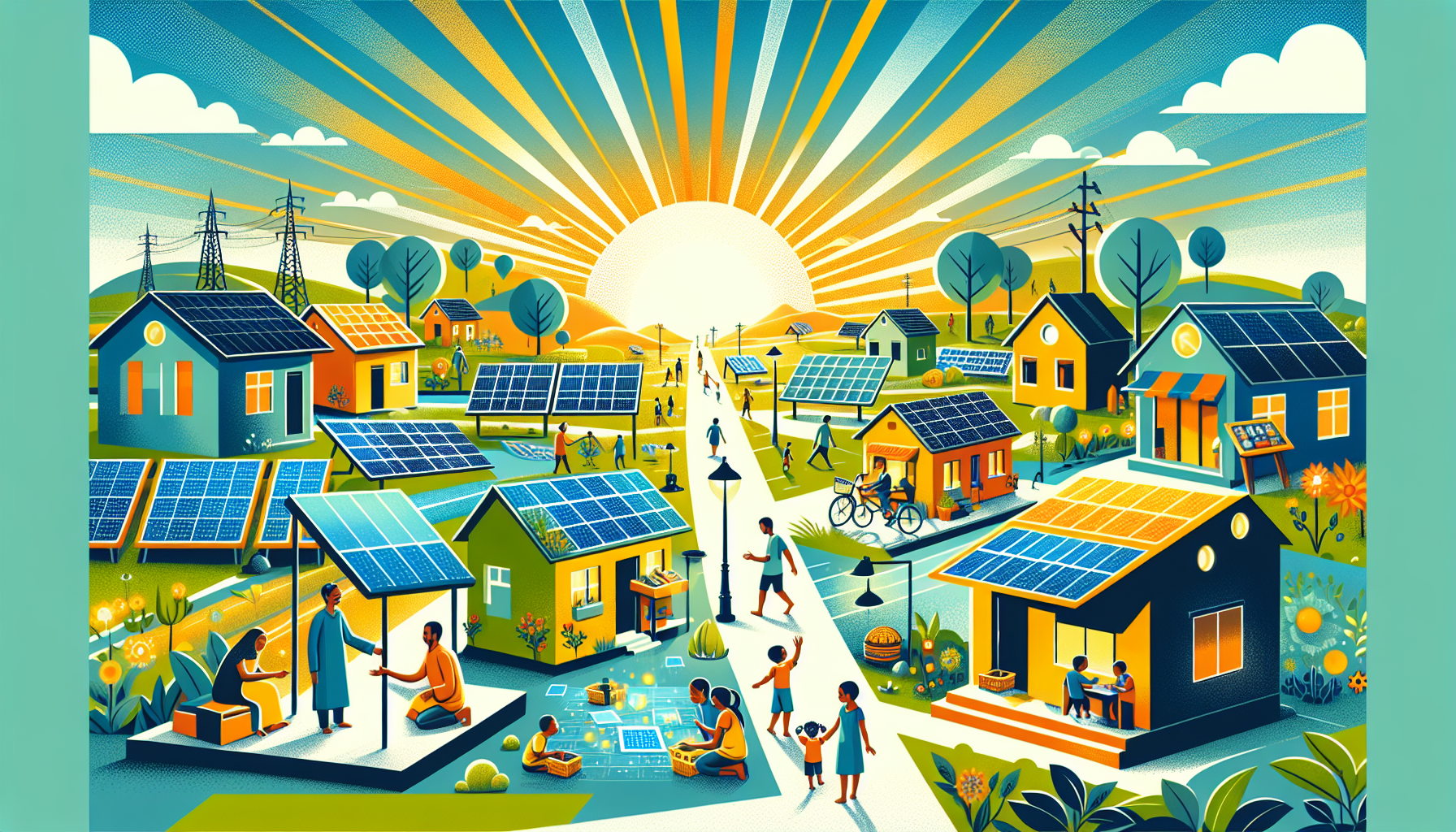
At the community level, reliable solar electricity enables micro-enterprises to extend operating hours, improves educational outcomes through evening study time, and supports critical healthcare infrastructure. In commercial applications, solar directly reduces operational costs for businesses previously dependent on expensive diesel generators, improving competitiveness and enabling expansion.
Case studies across multiple countries reveal how community-centered solar projects foster local ownership and technical capacity building. When projects incorporate training and maintenance programs, they create sustained economic benefits beyond initial installation. This “solarization” of local economies creates resilient systems that can operate independently of centralized infrastructure.
Challenges and Opportunities
Despite remarkable progress, significant barriers to wider solar adoption persist. World Bank analysis identifies several key challenges:

- Project Economics: Small project sizes in developing markets often struggle to attract financing due to high transaction costs relative to overall investment.
- Technical Barriers: Intermittency remains a challenge in regions without complementary energy sources or storage capabilities.
- Infrastructure Limitations: Unreliable grids in many developing nations complicate integration of variable solar generation.
- Regulatory Complexity: Lengthy negotiations and uncertain policy environments can delay projects for years, undermining investor confidence.
However, these challenges are increasingly being addressed through innovative approaches. Battery storage costs continue to decline, making solar-plus-storage increasingly viable for stabilizing intermittent generation. Meanwhile, modular and containerized solar solutions enable rapid deployment and scaling without extensive planning processes.
The development of solar microgrids represents perhaps the most promising opportunity, allowing communities to create reliable local power networks that can operate independently or connect to national grids when available. These systems blend traditional and advanced technologies to match specific community needs and resource availability.
A Brighter Future
Structured support mechanisms are accelerating solar adoption across developing nations. The World Bank’s Scaling Solar program, launched in 2015, demonstrates how streamlined frameworks can reduce development timelines from 5+ years to under 2 years for utility-scale projects. By standardizing processes and providing technical assistance, these initiatives are building sustainable markets rather than dependency.
Successful implementations showcase adaptability across diverse contexts. In the Maldives, rooftop solar installations with performance guarantees are replacing diesel generators on remote islands. In India, the National Solar Mission has catalyzed both large-scale solar farms and distributed systems serving rural communities. These examples provide replicable models for similar economies.
The most promising development is the increasing localization of solar technology production and maintenance. Studies show that regions with the highest solar potential—often called the “Sunbelt” countries across Africa, South Asia, and parts of Latin America—can develop manufacturing capacity that creates additional economic benefits beyond energy generation.
For developing nations navigating complex energy transitions, solar innovation represents more than technical advancement—it offers a pathway to energy independence, economic resilience, and sustainable development. By embracing these technologies and adapting them to local contexts, communities are illuminating a future where energy poverty becomes a challenge of the past.