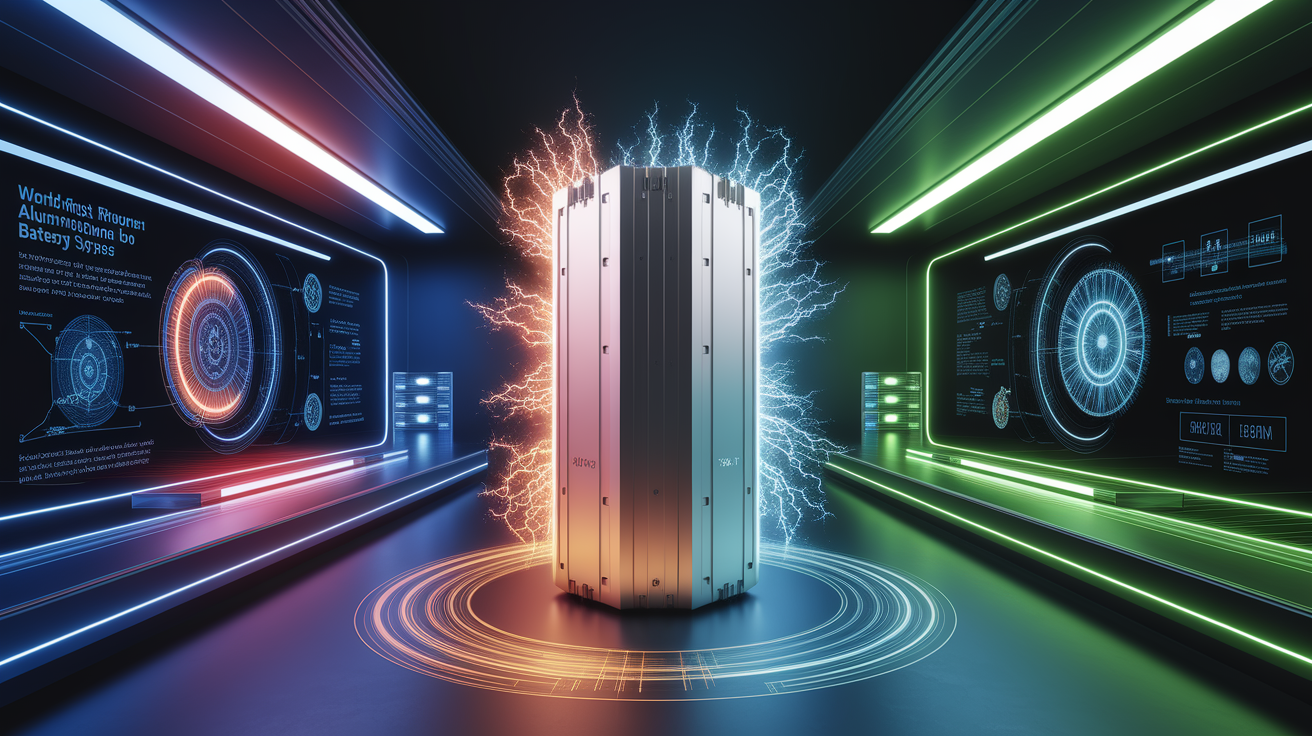
In a breakthrough that could redefine the economics and safety profile of grid-scale energy storage, the Fraunhofer Institute for Integrated Systems and Device Technology (IISB) has unveiled the world’s first operational aluminum-graphite-dual-ion battery (AGDIB) system capable of delivering high power output for demanding real-world applications. According to the original INNOBATT project report, the demonstrator bridges the gap between lab-scale innovation and commercially viable deployment, marking a pivotal moment for lithium-free energy storage technologies.
From lab bench to live grid scenarios
While aluminum-ion chemistry has long been explored for its theoretical benefits, actual high-power system integration has remained elusive—until now. The INNOBATT demonstrator integrates eight multi-layer AGDIB pouch cells with a wireless battery management system based on the open-source foxBMS platform, plus a diamond-based quantum sensor for precision current monitoring. This configuration has demonstrated stable operation under sustained 10C charge/discharge rates, emulating real-world grid frequency response conditions with minimal degradation.
Performance metrics are compelling: energy density at 160 Wh/kg, power density exceeding 9 kW/kg, and cycle life beyond 10,000 full depth-of-discharge cycles—all while maintaining nearly 100% Coulombic efficiency. For grid operators, this means a storage medium capable of delivering instantaneous bursts of power without the overcapacity often required in lithium-ion installations.
Why aluminum-ion matters now
With renewables driving variability in the grid, fast-response storage is becoming indispensable. Unlike lithium-ion systems—often optimized for energy density and vehicle range—AGDIB’s strengths lie in rapid charge/discharge cycles, extreme longevity, and intrinsic safety due to its non-flammable electrolyte.
- Abundant, low-cost materials: Aluminum and graphite are widely available and free from rare-earth supply chain constraints.
- Safety advantage: Non-flammable electrolytes reduce fire risk and simplify installation approvals for urban or sensitive environments.
- Design-for-recycling: Cells are engineered for easy disassembly and material recovery, aligning with circular economy principles.
Competitive positioning vs. lithium-ion
Advanced lithium-ion chemistries like NMC push energy densities past 300 Wh/kg, making them ideal for electric vehicles where range is paramount. However, their cost, reliance on constrained resources, and fire risk pose challenges for certain stationary applications. AGDIB’s role is not to replace lithium-ion wholesale but to complement it—targeting high-power, short-duration use cases such as frequency regulation, spinning reserve, and load shifting.
The emergence of aluminum-based variants, including aluminum-CO₂ systems explored by startups like Flow Aluminum, hints at a diversified battery ecosystem where different chemistries serve distinct niches.
Validated for grid-scale frequency response
One of the most demanding roles for storage is rapid frequency response—correcting grid imbalances within milliseconds. The INNOBATT demonstrator’s ability to emulate real frequency data without performance drop positions AGDIB as a promising candidate for utilities seeking agile, low-maintenance solutions. Unlike oversized lithium-ion banks, a properly designed AGDIB system could deliver the same response capacity with fewer cells, lowering capital and operational costs.
Sustainability built into the chemistry
AGDIB’s environmental credentials go beyond its operational profile. By avoiding cobalt, nickel, and other conflict minerals, it sidesteps geopolitical and ethical supply concerns. Non-toxic components and recyclable design ease end-of-life processing, reducing the environmental footprint. Some aluminum-based chemistries even offer dual functionality—such as carbon capture during operation—enhancing their appeal in a climate-conscious market.
Industry implications and next steps
Fraunhofer’s achievement signals that high-power aluminum-ion systems are ready to move from prototype to pilot deployment. For grid operators, this could mean leaner, safer, and more sustainable frequency regulation assets. For policymakers, it’s a proof point that regulatory frameworks encouraging circular design and rare-earth independence can yield tangible technology wins.
Looking ahead, scaling manufacturing, optimizing module architecture, and securing early adopter projects will be crucial. If these hurdles are cleared, AGDIB could emerge as a mainstream choice for high-power stationary storage within the decade—redefining how we stabilize renewable-heavy grids.