
As climate challenges intensify and land-use conflicts grow, innovative approaches that maximize resource efficiency are becoming essential. Agriculture-solar integration—known as agrivoltaics or dual-use solar—represents one of the most promising developments in both renewable energy and sustainable farming. By combining food production and clean energy generation on the same land, these systems create resilient, productive landscapes that deliver multiple benefits.
The Power of Dual Use
The fundamental principle driving agrivoltaics is remarkably practical: make the same land work twice as hard. Traditional approaches treat solar development and farming as competing land uses, but dual-use systems demonstrate they can be complementary—potentially utilizing land at up to 140% capacity compared to single-use scenarios.

These integrated systems aim to maintain at least 70% of original agricultural output while generating substantial clean energy. This efficiency addresses several pressing challenges simultaneously:
- Preserves agricultural land while expanding renewable energy capacity
- Creates climate resilience through diversified land use
- Provides farmers with stable income streams
- Reduces competition for finite land resources
“Land-use efficiency isn’t just about maximizing outputs—it’s about optimizing the relationship between energy infrastructure and agricultural practices,” says Dr. Emily Chen, agricultural economist. “When designed correctly, these systems create symbiotic relationships rather than competing interests.”
Innovative Agrivoltaics
Today’s agriculture-solar integration strategies range from simple to sophisticated, with various approaches tailored to different agricultural needs and site conditions. The most common implementations include:
Solar Grazing Systems
Perhaps the simplest form of agrivoltaics, these systems employ sheep, goats, or other livestock to manage vegetation beneath solar arrays. Benefits include:
- Natural vegetation control without herbicides
- Reduced maintenance costs for solar operators
- Additional income for livestock producers
- Preservation of grazing land while generating clean energy
This approach works particularly well with standard ground-mounted solar installations that require minimal modification.
Crop-Integrated Systems
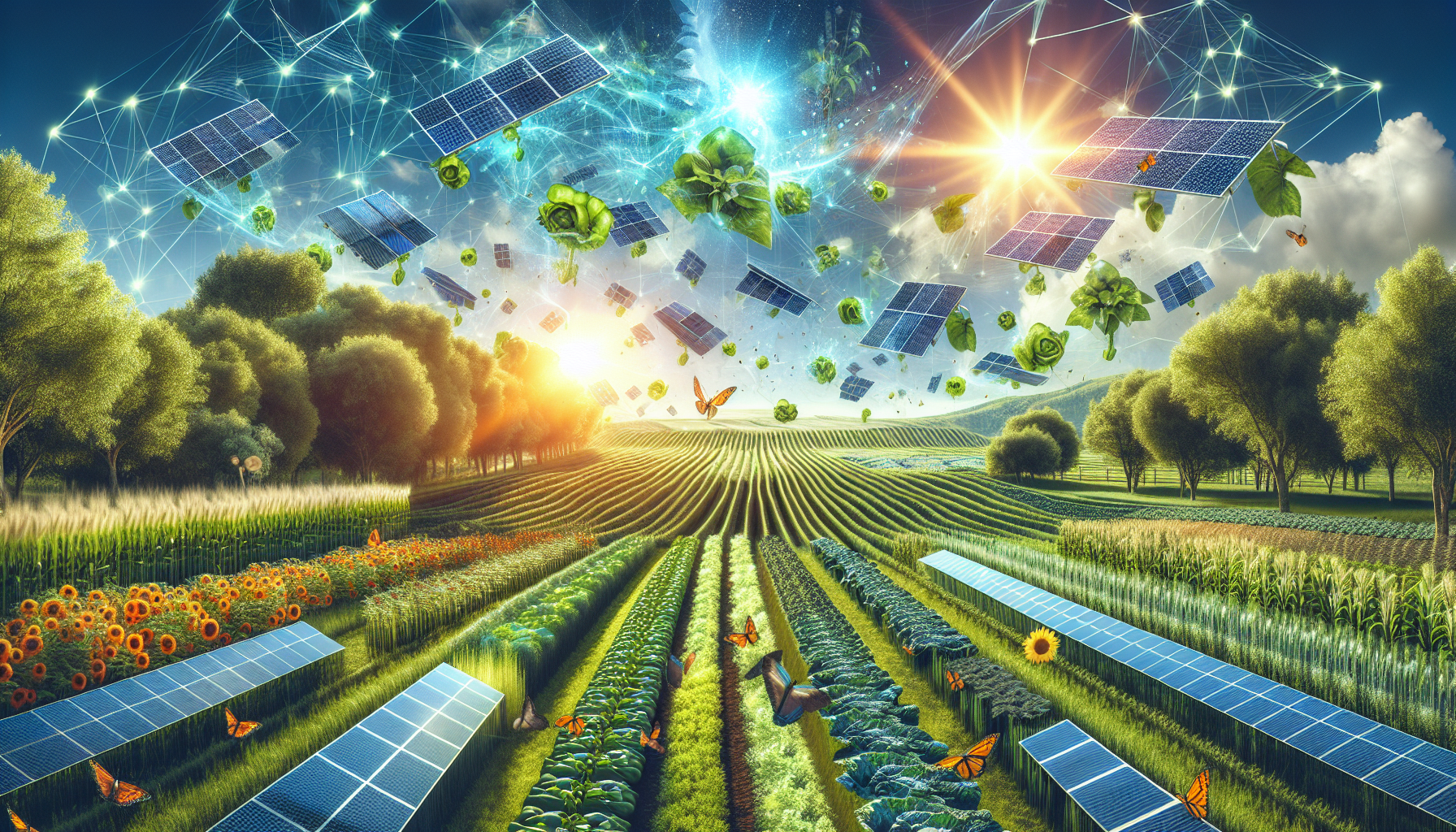
More sophisticated implementations involve direct integration with crop production. These systems typically feature:
- Elevated panels (2+ meters) allowing farm equipment access
- Strategic panel spacing to balance sunlight for crops
- Specialized mounting systems for crop compatibility
According to the InSPIRE project, these systems can be designed with three different optimization approaches:
- Solar-centric designs that minimize changes to standard solar configurations
- Vegetation-centric designs that prioritize agricultural productivity through wider panel spacing
- Co-optimization designs that seek balanced performance in both sectors
Advanced Technological Solutions
The cutting edge of agrivoltaics features innovative hardware specifically designed for agricultural integration:
- Vertical bifacial panels that allow machinery to move freely between rows
- Elevated rotary panels that can tilt to allow tractor passage
- Dynamic tracking systems that adjust to optimize either crop growth or energy production as needed
- Semi-transparent PV panels that filter specific light wavelengths beneficial to plants
Economic and Environmental Impacts
The benefits of agriculture-solar integration extend beyond simple land efficiency, creating measurable advantages for farmers, developers, and ecosystems alike.
Agricultural Benefits
Farm sustainability improves through multiple mechanisms:
- Energy cost reduction for irrigation, refrigeration, and machinery
- Water conservation through reduced evaporation (up to 30% in some studies)
- Extended growing seasons through microclimate management
- Protection from extreme weather events
- Diversified income that enhances farm financial resilience
“The partial shading from solar panels has actually increased yields for certain crops in hot, dry regions,” notes irrigation specialist Michael Rodriguez. “We’ve seen productivity improvements of 10-15% with some shade-tolerant varieties.”

Environmental Enhancements
Biodiversity gains represent one of the most significant environmental benefits of well-designed agrivoltaic systems. Studies from Enel Green Power projects show:
- Up to 20-fold increases in native bee populations with pollinator-friendly plantings
- Enhanced habitat connectivity for wildlife
- Carbon sequestration through improved soil management practices
- Reduced need for chemical inputs compared to conventional agriculture
These biodiversity improvements create cascading benefits throughout the agricultural ecosystem, from improved pollination services to natural pest control.
Developer Advantages
Solar developers also benefit from agrivoltaic approaches:
- Streamlined permitting processes in agriculture-protective regions
- Lower operations and maintenance costs through grazing partnerships
- Improved community relations and project acceptance
- Potential premium pricing for “solar-plus-agriculture” energy products
Policy and Incentives
Government support for agrivoltaics varies widely across jurisdictions, but is expanding as policymakers recognize the multiple benefits these systems provide.
Current policy mechanisms supporting agriculture-solar integration include:
- Direct financial incentives for dual-use system development
- Modified property tax treatments for agrivoltaic installations
- Research funding for optimized system development
- Specialized permitting pathways for agricultural solar projects
The U.S. Department of Energy has prioritized agrivoltaics research through its Solar Energy Technologies Office, funding projects that address design optimization, economic modeling, and environmental impact assessment.

“The policy landscape is evolving quickly as more data becomes available on agrivoltaics performance,” says policy analyst Jennifer Wilson. “We’re seeing increasing recognition that these systems address multiple policy priorities simultaneously—from renewable energy expansion to agricultural preservation to rural economic development.”
Challenges and Solutions
Despite their promise, agrivoltaic systems face several implementation challenges that require thoughtful solutions.
Technical Challenges
The primary technical obstacles include:
- Equipment compatibility: Standard solar mounting systems often lack sufficient clearance for agricultural machinery
- Light management: Different crops require specific light levels, making panel configuration critical
- Irrigation integration: Water systems must function around solar infrastructure
- Crop selection: Not all crops perform well in partially shaded conditions
Solutions increasingly focus on purpose-built systems with:
- Minimum 2-meter panel height to accommodate equipment
- Anti-tracking modes during key agricultural operations
- Specialized mounting systems designed for agricultural compatibility
- Crop selection guidance based on regional testing
Economic Challenges
The financial equation for agrivoltaics includes important considerations:
- Higher initial development costs (typically 10-20% above standard solar)
- Reduced energy output per acre compared to dedicated solar farms
- Complex revenue-sharing arrangements between farmers and developers
- Limited valuation of co-benefits in traditional financial models
As noted by industry analysts, subsidies are often required to make these projects economically viable in current markets, though costs continue to decline as the sector matures.
Best Implementation Practices
Successful agrivoltaic projects typically follow these established best practices:
- Early consultation with agronomists familiar with local conditions
- Site-specific evaluation of dual-use potential before design
- Collaboration with local botanists to develop appropriate native seed mixes
- Comprehensive stakeholder engagement throughout development
- Monitoring programs to quantify agricultural and environmental outcomes
“The most successful projects we’ve seen take a truly integrated approach from day one,” says agricultural solar consultant Thomas Murphy. “When agricultural expertise drives the design process alongside solar engineering, the systems perform substantially better.”
Future of Solar-Integrated Agriculture
The agrivoltaics sector is evolving rapidly, with several promising developments on the horizon:
Emerging Technologies
- Smart systems: IoT sensors and AI-driven management optimizing both energy and crop production
- Spectrum-selective PV: Panels that transmit specific light wavelengths beneficial to plant growth
- Modular designs: Systems that can be reconfigured seasonally based on crop needs
- Integrated water management: Solar structures that capture and distribute rainwater
Expanding Applications
Beyond traditional crop and livestock integration, new applications are emerging:
- Aquavoltaics: Combining solar with aquaculture operations
- Apivoltaics: Specialized designs for beekeeping integration
- Agrivoltaic greenhouses: Controlled environment agriculture with integrated PV
- Agroforestry solar: Long-term integration with tree crops and timber production
These innovations are expanding the potential applications for agriculture-solar integration across diverse agricultural contexts.
Shining a Light on the Path Forward
Agriculture-solar integration represents a powerful solution to multiple challenges facing our food and energy systems. By maximizing land productivity, enhancing agricultural resilience, and expanding clean energy production, these systems deliver benefits across economic, environmental, and social dimensions.
For farmers considering agrivoltaic adoption, the key steps include:
- Assessing site-specific opportunities based on current agricultural operations
- Consulting with experienced developers who prioritize agricultural compatibility
- Exploring available incentive programs and policy support
- Connecting with extension services and research institutions for technical guidance
- Starting with pilot projects to evaluate performance before wider implementation
As climate pressures intensify and land competition grows, these integrated approaches provide a template for how thoughtful design can transform apparent conflicts into complementary systems. The future of farming and energy production may well be found in the shade beneath the solar panel.