Hybrid Energy Systems Explained: Solar, Wind, Batteries, Generators, and Grid Control
Last reviewed August 2, 2026. Confirm current equipment manuals, site wind evidence, utility rules, incentives, contracts, and local requirements.
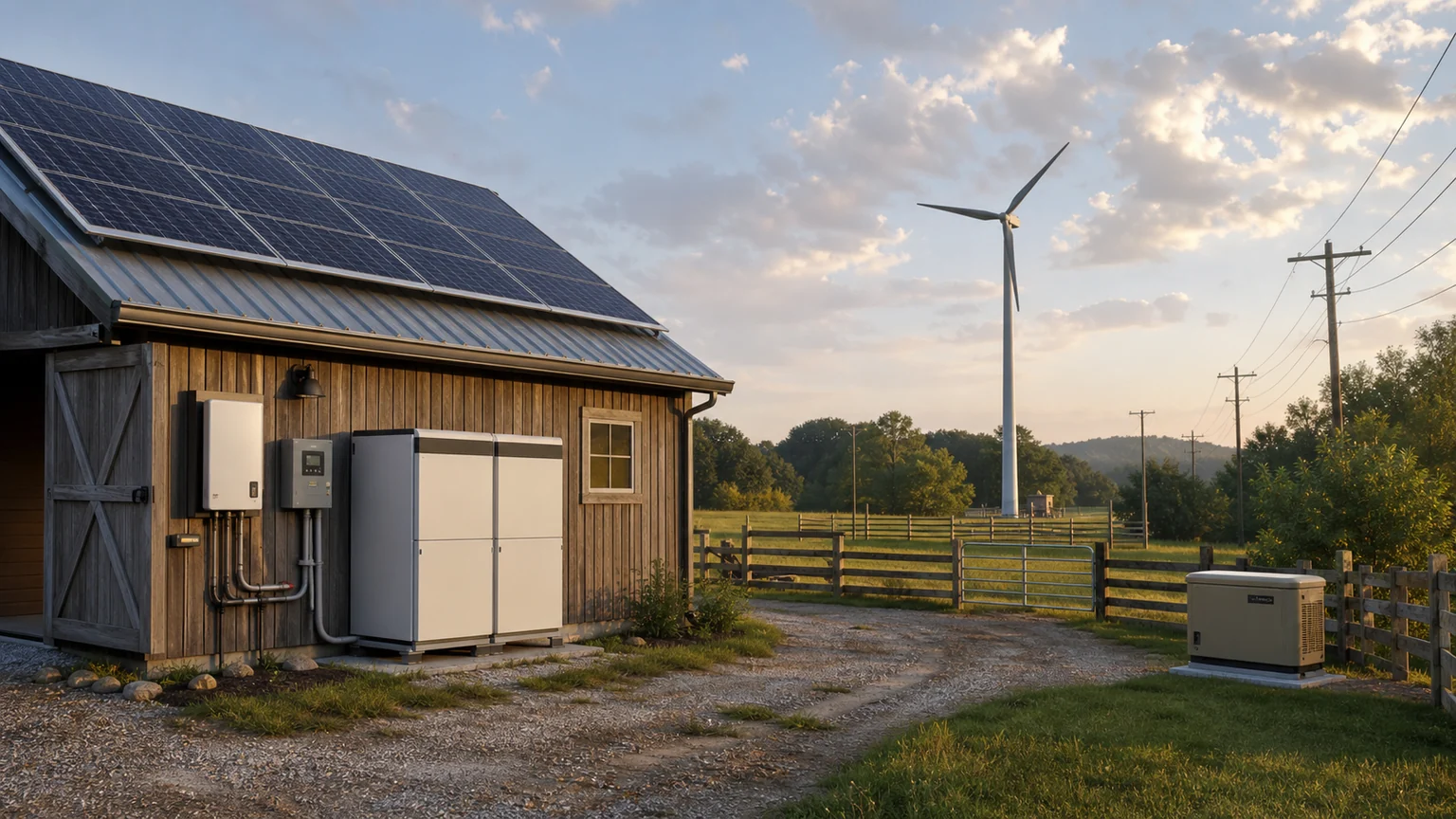
This page covers hybrid solar-wind-battery-generator systems broadly. For residential small-wind decisions, use the residential wind guides.
Start with the load and the outage requirement
A hybrid energy system is useful when no single resource can meet the required load profile, outage duration, or operating cost. Solar produces during daylight, a battery shifts a limited amount of energy, wind can complement solar at a suitable measured site, and a generator can cover long outages but needs fuel and maintenance. Grid service can lower cost when it is available, but it does not provide backup unless the system has code-compliant islanding equipment.
For a homeowner, farm, remote facility, or small business, the first decision is not which technology sounds most advanced. It is which loads must run, for how long, under which weather and utility conditions. The equipment and control strategy should follow that requirement.
Quick answer: what each part contributes
- Solar PV: usually the lowest-maintenance onsite generator, but output changes with season, cloud cover, shade, and array orientation.
- Wind: can complement winter or nighttime solar only where measured wind speed, turbulence, setbacks, noise rules, and service access support it.
- Battery storage: carries short outages, starts loads quickly, and shifts energy; its duration is limited by usable kWh, inverter power, temperature, reserve setting, and battery limits.
- Fuel generator: can cover longer interruptions when fuel is available, but adds noise, emissions, exercise cycles, maintenance, transfer equipment, and fuel-storage obligations.
- Utility grid: can be the most economical balancing resource, subject to tariff, export rules, demand charges, interconnection limits, and outage behavior.
- Controller or energy-management system: decides when to charge, discharge, curtail, start a generator, shed loads, or reconnect. Poor control logic can undermine otherwise good hardware.
Choose an architecture for the actual reader problem
Home backup
Separate critical circuits from convenience loads. Refrigeration, medical equipment, communications, well or sump pumps, selected lighting, and controls often matter more than whole-home air conditioning, resistance heat, an electric range, or an EV charger. Use measured running watts and startup surge, then decide whether the battery must cover hours or days.
Farm or rural site
Motor starts, pumps, refrigeration, ventilation, water systems, and seasonal operations can dominate the design. A long outage may justify a generator even when solar and batteries carry normal daily operation. Fuel delivery, livestock needs, remote monitoring, and service response time belong in the plan.
Commercial building
The economic case may depend on demand charges, time-of-use rates, power-quality needs, resilience value, or a limit on utility service capacity. Interval load data and the tariff matter more than a monthly electricity total. Identify which loads can be shifted and which processes cannot tolerate interruption.
Remote or off-grid site
Design around the worst credible renewable period, not the annual average. The system needs an energy budget, reserve policy, load-shedding sequence, maintenance plan, spare-parts strategy, and a realistic way to recover after several low-production days.
When wind belongs in a wind-solar hybrid
Do not add a turbine merely because wind and solar can be complementary in theory. Use hub-height site evidence and the turbine power curve to estimate monthly or hourly energy, then compare it with solar production and load. Wind adds value when the measured resource fills a real seasonal or overnight gap enough to justify the tower, foundation, permitting, controls, maintenance, and spare-parts burden.
For a small system, model solar-only, solar-plus-battery, generator-assisted, and wind-solar cases with the same reliability target. Keep the wind case only if it improves unmet-load hours or lifecycle cost under conservative resource assumptions.
- Confirm whether sources share a DC bus or connect on the AC side.
- Model charge-controller/PCS limits when both sources peak.
- Define curtailment, dump-load, battery-full, grid-outage, and black-start behavior.
- Retain a single-line diagram, controls narrative, commissioning test, and safe shutdown procedure.
See the residential and small-wind planning guide for tower, resource, zoning, and maintenance checks.
Build the load model before sizing equipment
- List every critical load. Record running watts, startup surge, hours per day, season, and whether the load can be deferred.
- Separate power from energy. Inverter kW determines what can run at one moment; usable battery kWh helps determine how long it can run.
- Use interval data where available. Fifteen-minute or hourly data reveals peaks that a monthly bill hides.
- Model poor renewable conditions. Include local winter sun, storm periods, high temperature, snow, smoke, shade, and realistic wind data.
- Define reserve and recovery. Decide the minimum state of charge, when a generator may start, which loads shed first, and how the battery recovers after an outage.
- Check equipment limits together. Confirm PV string voltage, inverter surge, battery discharge power, generator compatibility, transfer method, grounding, communications, and firmware support.
Use NerdVolt's Critical Loads Calculator and Battery Backup Runtime Calculator to organize the first pass. These tools are planning aids; final design should use equipment manuals, site data, permit requirements, and a qualified designer or electrician.
Controls, islanding, and black-start behavior
A grid-connected solar array normally shuts down during an outage unless listed equipment creates a safe local grid. A hybrid inverter, transfer device, microgrid controller, or other listed equipment must isolate the site from utility lines before energizing backed-up circuits. This protects utility workers and prevents equipment damage.
Ask the designer to explain, in plain language, what happens when the grid fails at night, the battery is nearly empty, a large motor starts, the generator fails to start, communications are lost, or solar production exceeds the loads. Also ask whether the system can restart from a depleted state without the grid and how firmware or cloud-service outages affect operation.
Cost and performance questions that prevent oversizing
- What outage duration is the design intended to cover, and under what load assumption?
- How much battery energy is usable after reserve, temperature, conversion loss, and age are considered?
- Which savings depend on a current utility tariff, export rate, incentive, tax rule, or demand-charge schedule?
- Does the proposal include service upgrades, switchgear, trenching, roof work, structural work, permitting, monitoring subscriptions, generator fuel, and maintenance?
- Can a smaller battery plus disciplined load shedding meet the same resilience goal?
- How will batteries, inverters, generators, and controls be serviced if one vendor leaves the market?
Safety and professional boundaries
Hybrid systems combine multiple energy sources, which means several fault paths may remain energized. Permanent wiring, service equipment, transfer devices, generators, batteries, grounding, overcurrent protection, rapid shutdown, ventilation, and fire access should be designed and installed under the adopted local codes and manufacturer instructions. A licensed electrician, qualified solar or storage designer, utility, permitting authority, and fire official may all have roles.
Do not energize an improvised backfeed connection or use a portable generator indoors or near openings. Keep emergency shutdown instructions, equipment manuals, single-line diagrams, labels, monitoring access, warranty records, and service contacts with the system.
Sources and planning references