Solar Desalination: Technologies, Energy Use, Costs, and Practical Limits
Last reviewed July 22, 2026.
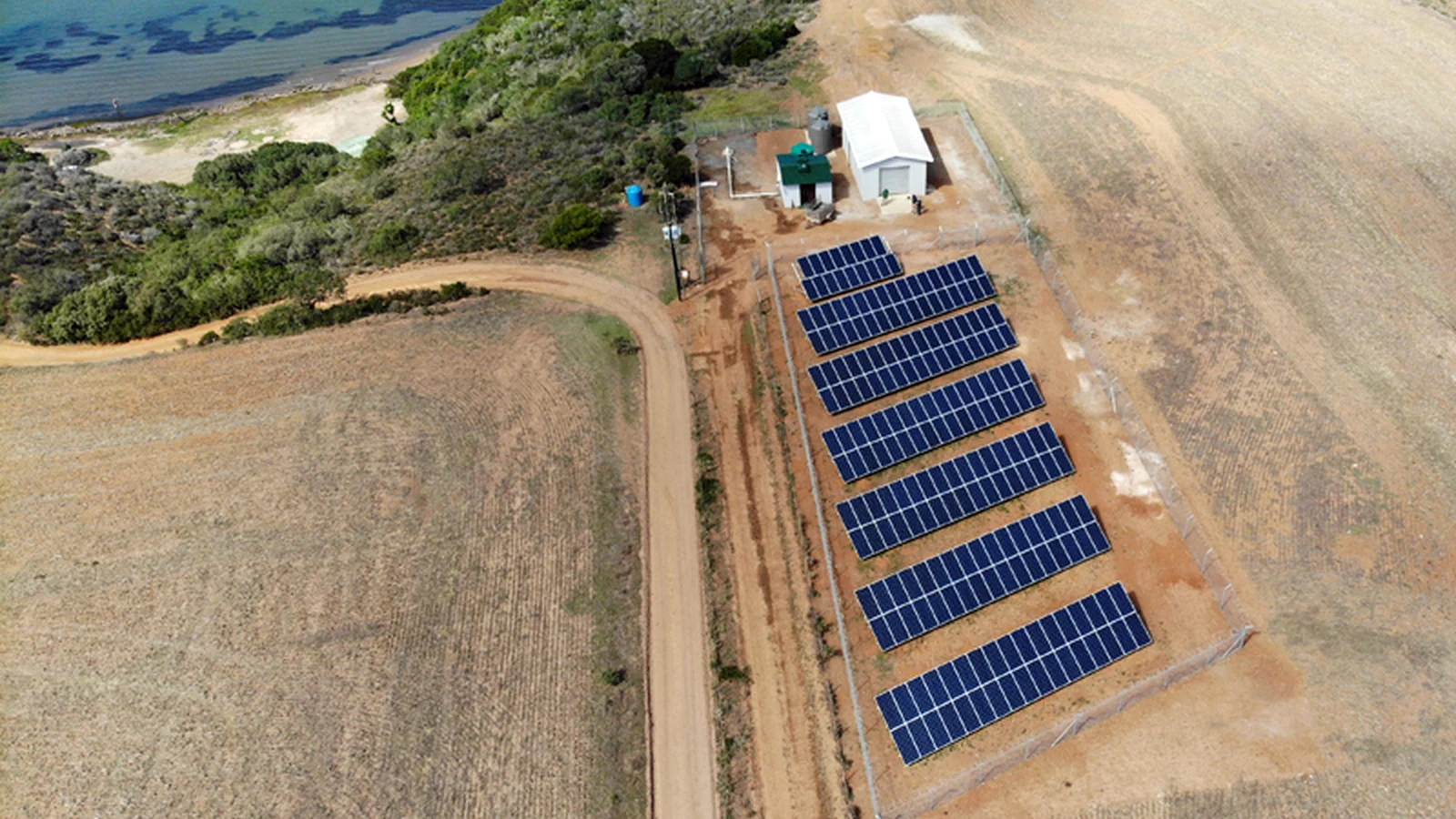
“Solar desalination” describes an energy source paired with a water-treatment process, not one machine. For many commercial projects, the most mature route is solar electricity serving reverse osmosis through a grid, microgrid, or dedicated power system. Thermal, membrane-distillation, electrodialysis, and interfacial-evaporation approaches can fit narrower conditions, but their energy, feed-water, maintenance, and scale limits are different.
Start with the water requirement, not the solar device
Record the required product-water quality and daily volume, feed-water salinity and temperature, seasonal turbidity and biology, intake and discharge options, operating hours, operator capability, energy source, storage strategy, and redundancy. A treatment train that works with clean brackish groundwater may fail on warm coastal water with algae, silt, oil, or rapid salinity changes.
Technology comparison
| Route | Where it can fit | Main limits to resolve |
|---|---|---|
| Solar PV powering reverse osmosis (RO) | Brackish-water and seawater systems from remote packages to municipal plants, when the complete intake, pretreatment, pressure, cleaning, and concentrate train is engineered. | Feed pressure, pretreatment, membrane fouling and scaling, energy recovery, variable power, cleaning chemicals, membrane replacement, and brine discharge. |
| Solar thermal distillation | Sites with useful solar heat, thermal storage, waste heat, or cogeneration and a reason to use evaporation/condensation rather than pressure membranes. | Large heat requirement, heat-exchanger scaling, corrosion, condenser performance, thermal storage, and high capital intensity. |
| Membrane distillation | Projects with low-grade heat or a research/pilot objective; it can reject nonvolatile salts through a hydrophobic membrane. | Heat loss, low thermal efficiency without heat recovery, membrane wetting, scaling, fouling, module cost, and limited long-duration field evidence at large scale. |
| Electrodialysis | Often better suited to brackish water, where moving ions through selective membranes can use less energy than removing nearly all water from salt. | Energy rises with salt removal, membrane scaling/fouling, electrode and stack maintenance, concentrate handling, and product-water targets that may require polishing. |
| Interfacial solar evaporation | Research, small passive devices, crystallizers, or special concentrate-management concepts. | Condensing and collecting vapor, salt accumulation, contaminated feed, weather, heat loss, area requirement, material durability, and moving from illuminated coupon to complete water system. |
Energy required per unit of water
Energy must be reported per cubic metre of delivered product water, with the process boundary and feed water stated. The World Bank's 2019 institutional review compiled 3–7 kWh of electricity per cubic metre for seawater reverse osmosis (SWRO). The same review reported total equivalent electrical-energy ranges of 5.2–7.3 kWh/m³ for MED with thermal-vapour compression, 6.5–11 kWh/m³ for MED, and 9.0–12.5 kWh/m³ for multistage flash. Those are literature ranges, not promises for a new plant.
IRENA's 2012 technology brief reported about 3.5–5.0 kWh/m³ of electricity for the large-scale RO cases it summarized. The date and assumptions matter: feed salinity, recovery, pretreatment, pressure, energy-recovery equipment, plant size, product quality, and pumping outside the desalination block can move the result.
Electrodialysis and membrane-distillation projects should not borrow an SWRO figure. Electrodialysis energy depends strongly on how much salt must be moved. Membrane-distillation reports must separate supplied thermal energy from electricity and state whether waste heat or solar heat was counted as free.
Feed-water salinity changes the design
Higher salinity raises osmotic pressure for RO and generally increases the work required to separate water. Brackish groundwater can require less pressure than seawater, but it may carry silica, hardness, iron, organics, or disposal constraints that dominate the design. Thermal systems are less sensitive to osmotic pressure but still face scaling, corrosion, and heat-transfer losses.
Pretreatment, fouling, and cleaning are core equipment
An RO plant is not just panels, a pump, and membranes. Intake screening, coagulation or filtration where needed, cartridge filtration, chemical dosing, monitoring, clean-in-place equipment, post-treatment, and disinfection may be part of the system. Algae, suspended solids, microorganisms, oil, hardness, and silica can reduce flux, raise pressure, damage membranes, or force shutdowns.
Membrane-distillation and electrodialysis systems have different membranes, but they are not immune to wetting, scaling, organic fouling, or biofouling. A pilot must run long enough and across enough feed conditions to show cleaning frequency, recovery after cleaning, consumables, and irreversible performance loss.
Brine and concentrate disposal can decide whether the project is viable
Every desalination process separates product water from a more concentrated stream. The amount and composition depend on feed water and recovery. Ocean discharge may require an outfall, mixing analysis, permits, and monitoring. Inland systems may need evaporation ponds, deep-well injection, sewer acceptance, hauling, crystallization, or another site-specific route. “Zero liquid discharge” shifts the problem into additional energy, solids handling, and capital; it does not make salt disappear.
Storage and capacity factor
A directly coupled solar plant follows irradiance unless it has grid support, another generator, electrical storage, thermal storage, or water storage. Storing treated water can be simpler than storing enough electricity to run all night, but the tank, water quality, pumping, reserve volume, and production-recovery plan still need design.
Do not equate the solar array's capacity factor with desalination-plant utilization. A plant may operate fewer hours at higher flow, run continuously from a grid-backed renewable supply, or use water storage to separate production from demand. Repeated starts and stops can affect flushing, pressure control, membrane condition, and operator workload.
Capital cost versus operating cost
- Capital cost: intake, wells or beach galleries, pretreatment, process modules, pumps, energy recovery, solar array, power electronics, storage, buildings, civil works, brine disposal, controls, laboratory equipment, permitting, engineering, and contingencies.
- Operating cost: energy, labour, chemicals, cartridges, membranes, electrodes, cleaning, monitoring, residuals, parts, insurance, compliance, and major replacement reserves.
A low module price or impressive solar absorber does not establish low water cost. Conveyance and distribution can exceed treatment cost when water must be lifted or transported. Small remote systems lose economies of scale and may need simpler controls, local spares, and an operator plan; municipal systems need redundancy, continuous compliance, intake and outfall approvals, and financeable long-term performance.
Pilot-scale versus commercial deployment
A laboratory result answers a narrow question under defined light, temperature, area, feed, and collection conditions. A commercial project must also supply and pretreat feed water, condense and collect vapor where applicable, manage concentrate, survive weather, clean itself or be cleaned, meet water-quality requirements, and operate for years.
For an evaporation experiment, a simple scale-up check is:
daily collected water = reported flux × active area × effective operating hours × availability × collection efficiency
Each multiplier needs evidence. The illuminated laboratory area may exclude the condenser, spacing, insulation, plumbing, salt-management area, cleaning downtime, cloudy periods, and losses. Doubling absorber area does not guarantee double delivered water because heat and mass transfer, vapor removal, edge losses, salt transport, and collection geometry change with scale.
Decision checklist
- Test feed water across seasons and define product-water standards.
- Compare treatment processes before choosing the solar architecture.
- State energy in kWh per cubic metre with a clear process boundary.
- Design pretreatment, cleaning, consumables, redundancy, and operator tasks.
- Secure a permitted concentrate route before relying on a water-cost estimate.
- Model solar variability, water storage, backup power, recovery, and downtime.
- Require pilot data that include collection, fouling, cleaning, weather, and long-duration operation—not only peak flux.
- Separate quoted equipment price from installed capital and lifetime operating cost.
Sources
- World Bank, The Role of Desalination in an Increasingly Water-Scarce World (2019) — institutional review of process energy, feed-water effects, costs, pretreatment, and project scale.
- IRENA, Water Desalination Using Renewable Energy (2012) — dated technology benchmark for renewable-process pairings and energy ranges.
- U.S. Department of Energy: Solar Desalination — program and project context; funded research is not the same as commercial deployment.
- Dongare et al., “Nanophotonics-enabled solar membrane distillation for off-grid water purification,” PNAS (2017) — primary research on a solar membrane-distillation concept.
- Warsinger et al., “Flexible batch electrodialysis for low-cost solar-powered brackish water desalination,” Nature Water (2024) — primary research on variable-power electrodialysis for brackish water.
- Tao et al., “Interfacial Solar Evaporation: From Fundamental Research to Applications,” Advanced Materials (2024) — research review used for laboratory-to-application limits.
Additional primary and technical references
Use these references to verify thermal and membrane configurations, passive designs, energy recovery, pretreatment, brine handling, and the boundary between research prototypes and deployable systems.