Canada Solar-Module Duties: Product Exclusion and Expiry-Review Status
Last reviewed August 10, 2026. Verify current product documents, official rules, and local requirements before acting.
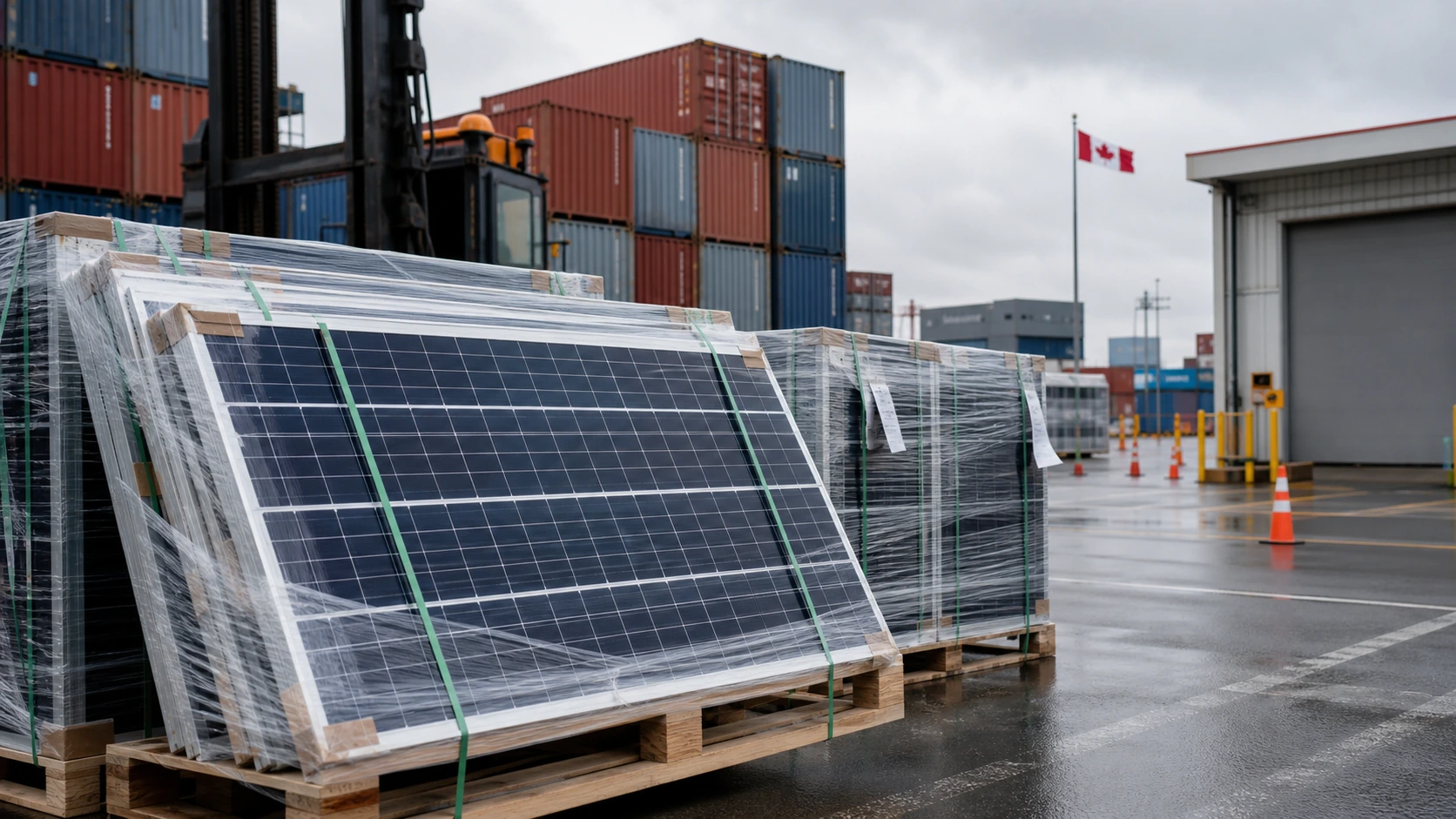
Canada's proceeding is not a general review of every solar product or every imported panel. It concerns an anti-dumping and countervailing order on defined photovoltaic modules and laminates from China. A separate product-exclusion issue for low-power flexible modules used on curved vehicle surfaces was decided on March 13, 2026; the broader expiry review is still underway.
What the Canadian measure concerns
The controlling product definition covers photovoltaic modules and laminates made with crystalline-silicon cells, plus named thin-film photovoltaic products, when they originate in or are exported from China. The official definition contains exclusions, so a product name, wattage label, seller description, or tariff code alone is not enough to decide whether a shipment is subject to the measure.
The Canada Border Services Agency (CBSA) Measures in Force entry for photovoltaic modules and laminates is the operational source to check for the current definition, exclusions, exporters, normal values, and enforcement information.
The exact flexible-module category that was reviewed
Kings Solar Solutions Inc. sought an exclusion for flexible photovoltaic modules intended for curved vehicle surfaces such as transport-truck fairings. The Canadian International Trade Tribunal (CITT) had declined the earlier request in interim-review request RD-2023-001 on June 10, 2024 because the record then indicated that Canadian producers could make identical or substitutable products.
After a new request and changed evidence, the CITT conducted RD-2025-001. As a historical record, its March 13, 2026 order and reasons amended the 2021 order to exclude flexible photovoltaic modules that will be affixed to curved surfaces of vehicles, such as transport-truck fairings, with a power output not exceeding 200 W. That wording is narrower than “flexible solar panel.” All listed conditions matter.
Current proceeding status
| Proceeding | Status on July 20, 2026 | What it decides |
|---|---|---|
| RD-2025-001 interim review official CBSA review record | Decided March 13, 2026 | The specified flexible vehicle modules up to 200 W were excluded from the order. |
| CBSA SML 2026 expiry-review investigation | Determination issued July 2; reasons issued July 17 | The CBSA determined that expiry of the order would likely result in continued or resumed dumping and subsidizing of the subject goods from China. |
| CITT RR-2025-008 expiry review | Ongoing | The CITT must decide whether expiry of the order is likely to result in injury to Canadian industry. |
The CBSA's determination does not by itself decide whether the order continues. It advances the process to the CITT's injury inquiry.
Who may be affected
- Canadian importers: they need the exact product definition, origin/export facts, supplier information, and current CBSA instructions before pricing landed cost.
- Chinese exporters and producers: normal values, export prices, subsidy findings, and cooperation with CBSA processes can affect duty exposure.
- Canadian module producers: the expiry review considers whether resumed or continued dumping and subsidizing would likely injure domestic industry.
- Fleet and vehicle-system buyers: the March 2026 exclusion may matter only when the imported module satisfies every part of the vehicle-surface and power-output wording.
- Project developers and distributors: quoted module prices may not show trade-remedy exposure, and the broader order can change after the expiry review.
What remains undecided
The CITT has not yet issued its RR-2025-008 order on whether the broader measure should be continued or rescinded. The March product exclusion is already reflected in the revised expiry-review notice, but other product-exclusion requests and the injury record follow the Tribunal's process and deadlines. This page cannot determine the treatment of a particular shipment.
The next official dates to check
The CITT's revised RR-2025-008 notice and schedule lists these next milestones after this page's review date:
- July 24, 2026: replies to CITT expiry-review questionnaires.
- August 24, 2026: distribution of Tribunal exhibits and the investigation report.
- August 31, 2026 at noon Eastern: requests for product exclusions.
- September 28, 2026: scheduled start of the hearing.
- December 9, 2026: deadline for the CITT order and statement of reasons.
Schedules can be revised. Before acting, check the current CITT notice, the case record, and the CBSA Measures in Force page rather than relying on these copied dates alone.
Official sources
- CITT RD-2025-001 order and reasons, March 13, 2026 — final decision on the flexible vehicle-module exclusion.
- CITT RR-2025-008 revised notice and schedule, March 13, 2026 — scope, process, deadlines, and next decision.
- CBSA notice of conclusion, July 2, 2026 — expiry-review determination on likely continued or resumed dumping and subsidizing.
- CBSA statement of reasons, July 17, 2026 — evidence period, participation, analysis, and reasons.
- CBSA Measures in Force: Photovoltaic Modules and Laminates — current enforcement definition and exclusions.