LiFePO₄ Chemistry and Fundamentals: Structure, Voltage, and Tradeoffs
Updated July 17, 2026. Confirm current equipment manuals, utility rules, incentives, contracts, and local requirements before acting.
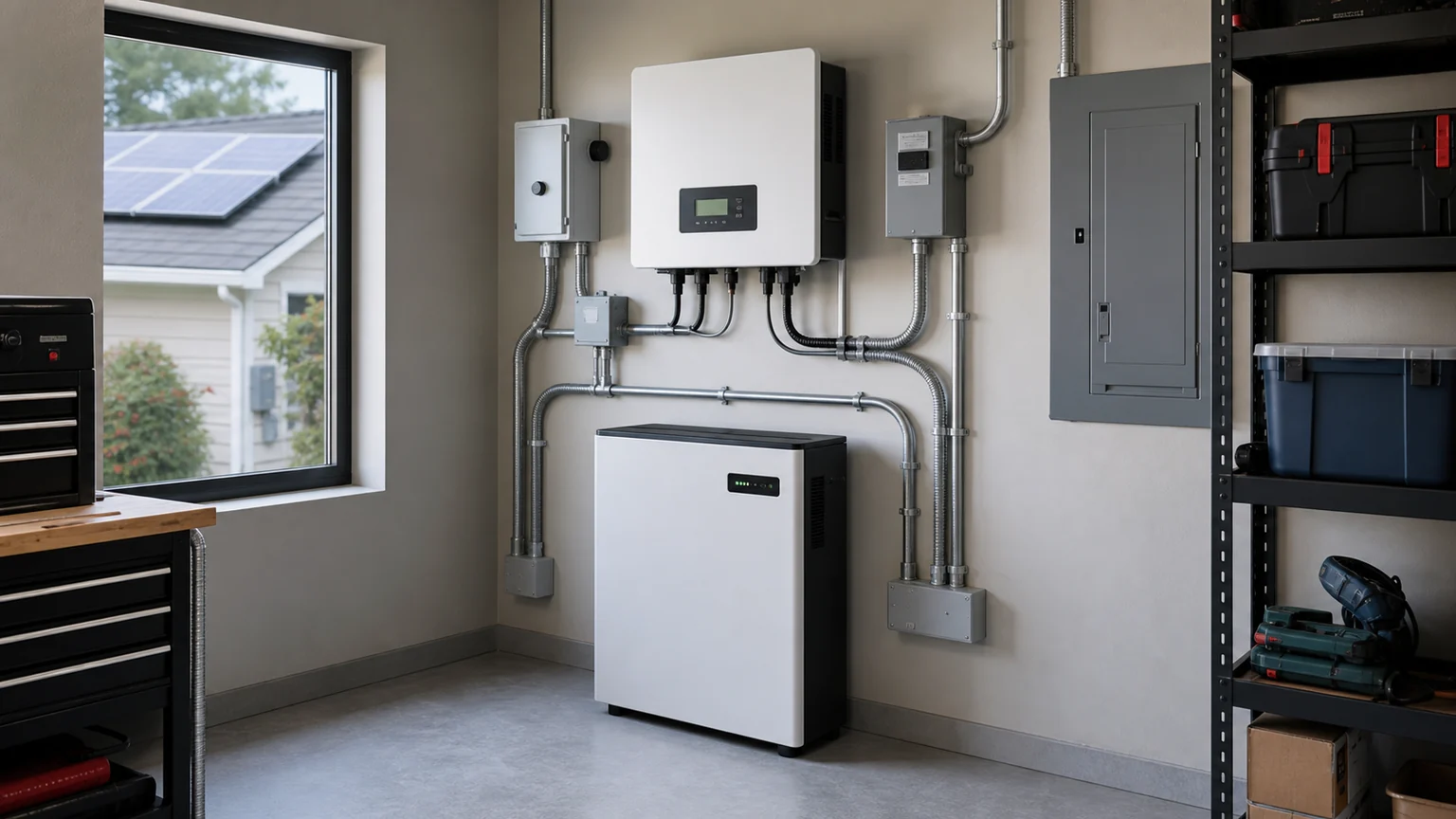
This page is the chemistry and fundamentals spoke. It explains what LFP is, how chemistry differs from pack design, and which claims require cell, pack, or installation evidence.
LiFePO₄ is a battery chemistry, not a complete system specification
Lithium iron phosphate, usually shortened to LiFePO₄ or LFP, is widely used for solar storage, backup power, RV house banks, marine auxiliary systems, portable power, and some electric vehicles. It is valued for long cycle life, stable voltage, and comparatively strong thermal stability, but those advantages do not make every battery interchangeable or suitable for every installation.
The safe answer depends on the exact cells, battery-management system, enclosure, terminals, charger, inverter, communication protocol, temperature range, fusing, conductor size, installation location, and applicable code. Use the battery and equipment manuals as the controlling source for settings and wiring.
Quick buyer answer
- Choose capacity from the load and required runtime, then confirm the battery can deliver the inverter's continuous and surge power.
- Match the charger or inverter/charger to the battery maker's voltage, current, temperature, and communication requirements.
- Confirm low-temperature charge protection; many LFP cells should not be charged below the maker's permitted temperature without a manufacturer-supported heating strategy.
- Do not mix batteries of different models, ages, capacities, firmware, or state of charge unless the manufacturer expressly supports the arrangement.
- For permanent building, marine, vehicle, or high-energy installations, use qualified design and installation help appropriate to the jurisdiction and use case.
What the nameplate should tell you
- Nominal voltage and energy: amp-hours alone are not enough. Compare watt-hours or kilowatt-hours at the stated nominal voltage.
- Continuous and peak current: these limits determine whether the battery can support the inverter and motor-start surge.
- Series and parallel rules: the manufacturer should state whether multiple batteries may be connected, how many, and how they must be balanced, protected, and cabled.
- Listings and application limits: a battery sold for portable or vehicle use may not meet requirements for a permanently installed home energy-storage system.
Charging and temperature
LFP charging settings vary by pack design and cell count. Do not copy a voltage from a generic chart when the battery manual provides a different limit. Confirm bulk or absorption voltage, float behavior, charge current, low-temperature cutoff, high-temperature cutoff, and whether equalization or temperature compensation should be disabled.
Cold charging deserves special attention. A battery may still be able to discharge in cold weather even when charging is restricted. Some products include low-temperature cutoff or heating, while others rely on the charger or installer. Confirm how the protection works, where the temperature sensor is located, and what happens when solar production appears while the battery is too cold to accept charge.
The BMS protects limits; it does not replace system design
A battery-management system monitors cell voltage, current, temperature, and other conditions, then may limit or disconnect the pack. That shutdown is a protective event, not a routine operating strategy. Repeated BMS trips can point to an undersized battery, excessive surge, incompatible charger settings, loose connections, poor temperature control, or a fault.
When a battery communicates with a supported inverter or charger, confirm the required cable, protocol, firmware, addressing, and settings. Without communication, conservative voltage and current settings become especially important. Never bypass the BMS to force a battery to charmarine use cases
Solar, backup, RV, and marine use cases
Solar and home backup
Start with critical loads, desired outage hours, inverter surge, and recovery after a low-sun period. A battery that has enough kWh can still fail the design if its discharge-power limit is too low. Permanent home systems may require listed equipment, code-compliant enclosures, fire separation, setbacks, permits, and utility coordination.
RV and marine house banks
Alternator charging, shore power, solar controllers, fusing, cable length, compartment temperature, and battery isolation all matter. Replacing lead-acid with LFP can change charger behavior and alternator loading. Use equipment intended for the application and involve a qualified technician when modifying high-current DC systems.
Portable power and small off-grid systems
Confirm connector rating, cable gauge, fuse location, enclosure protection, ventilation instructions, and whether the product may be used while charging. Keep the battery away from floodwater, physical damage, excessive heat, and unapproved chargers.
Series and parallel connections
Both can create high fault current. Do not assume that two batteries with the same advertised voltage can be combined.
Warning signs and safe response
Stop using the system and isolate it according to the manufacturer or emergency plan if you notice swelling, unusual heat, smoke, odor, melted insulation, damaged terminals, water intrusion, repeated protective shutdowns, or a charger that will not follow the expected profile. Do not open a sealed pack or improvise a repair. For fire, smoke, or immediate danger, move away and contact emergency services.
Questions to ask before buying
- What exact inverter, charger, alternator charger, and solar controller are supported?
- What are the continuous and surge current limits at the expected temperature?
- Does low-temperature charge protection come from the battery, charger, or a manufacturer-supported heater?
- How many batteries may be placed in series or parallel, and what protection is required?
- What listing or certification applies to this model and intended installation?
Sources and safety references
- U.S. Department of Energy: solar energy and storage basics
- UL Solutions: batteries and energy storage resources
- NFPA: electrical code adoption and enforcement resources
- Ready.gov: power outage planning
- LiFePO₄ charging limits and settings
- Battery backup runtime calculator
- Battery bank sizing calculator
- Battery chemistry comparison
How to verify the numbers on this page
This page covers LiFePO₄ Chemistry and Fundamentals: Structure, Voltage, and Tradeoffs. Figures here depend on the exact model, site, policy, study, test method, operating conditions, system boundaries, and comparison baseline. Verify current manufacturer, regulator, standard, or primary-research documents before acting.